

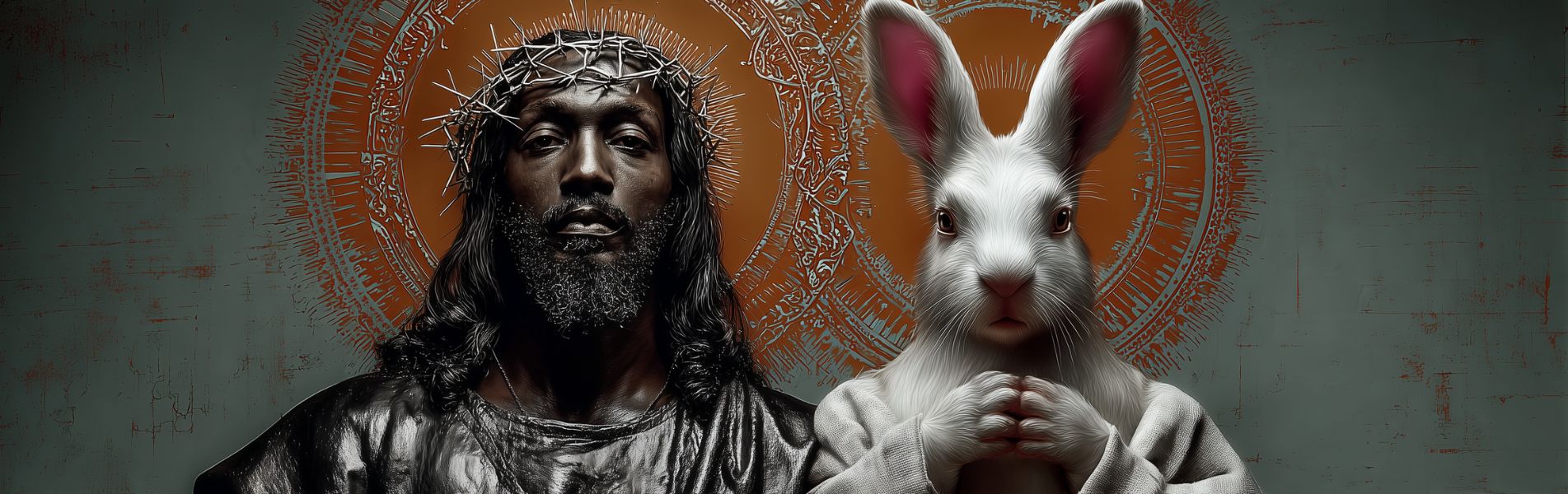
On Friday, I was asked a question that required a nuanced answer. It was 3:51 p.m. when a former co-worker texted me: “Do Adventists celebrate Good Friday?” The way the question was phrased revealed an underlying assumption that there is a degree of coherence across the diverse expressions of Adventism, such that one could reasonably expect a unified position on Good Friday and, by extension, on the broader set of observances commonly associated with the Easter celebration. I had to organize my thoughts around Haitian Adventism and Easter.
I could not simply respond by stating what my particular sector of Adventism thinks. I paused before replying. I had to broaden my answer to account for the range of differences I knew were at play, while still avoiding the risk of overwhelming the person who posed the question. She understood the essence of what I conveyed: not all Adventists hold the same perspective on such matters. If the world church had taken an official position and had gone through painstaking measures to communicate that decision broadly, that would be one thing. But that has not occurred.
The world church has not taken such a measure. At least, that is what I know at this point. What I can speak to with some degree of certainty is how Easter is regarded within what I have come to identify as Northeastern Haitian American Adventism.
By way of clarification, my focus on this sector of Adventism stems primarily from its proximity to my own experience. It is the Adventism to which I belong. I am aware that there are significant similarities between this expression of Haitian Adventism and those found in other parts of North America, as well as in Haiti and beyond. However, I do not possess sufficient familiarity with the broader landscape to speak about those contexts with equal confidence. There may well be nuances in those other settings that I am not in a position to observe or articulate.
Northeastern Haitian American Seventh-day Adventists do not celebrate Easter in any form. (An argument can be made for communion?) Easter is generally regarded as a pagan holiday. Unlike Christmas, which my parents permitted my three siblings and me to experience at home through decorated Christmas trees, wrapped gifts, and seasonal songs played on a record player my father owned, nothing was done in recognition of Easter.
I did not hear anything at home about the holiday. There was no mention of paganism, nor was there anything affirming about the resurrection. What I did hear came primarily from church. Some made it a point to go through what they understood to be the historical background of the holiday, with the clear intention of ensuring that we were fully aware that it was something we ought to avoid entirely. A significant amount of historical information was shared during that time by those who believed it was essential to emphasize the distinction that should exist between us and those who celebrated the holiday, on the grounds that it was not of God. In fact, the most accurate way I can express it is to say that one could easily come away with the impression that any association with Easter was not only inappropriate, but potentially dangerous.
Allow me to pause here and make what I believe is an important distinction. The Christian celebration of Easter does not, in its theological or liturgical core, feature rabbits or other elements that lack biblical significance. While many Christians may participate in or host events where the Easter rabbit is present, they do not do so with the intention of conveying any form of spiritual meaning through the rabbit, baskets filled with candy, decorated eggs, or similar items. As with Christmas celebrations, and perhaps even Halloween, these elements have become part of the broader cultural practices that accompany the observance of the season.
In the overwhelming majority of the treatments I grew up hearing on the subject, no distinctions were made between what the wider Christian world clearly recognizes as the celebration of the resurrection of Jesus and what others, across various cultural and religious persuasions, observe as a universal holiday not necessarily tied to Christianity. Instead, we were immersed in elaborate descriptions of Ēostre, or Ostara, a pagan Germanic goddess of spring and fertility, along with accounts of the spring equinox as a period during which baskets of flowers and food were offered to gods and goddesses.
At one point, many of the young Haitian Bible enthusiasts were well-versed in explaining the origins of various symbols associated with the Easter celebration. It did not help that the holiday appeared to bear the name of that ancient goddess. This association led to the widespread assumption that holding any kind of celebration during that time period, especially one involving so many of these familiar symbols, was tantamount to engaging in the worship of the goddess herself.
Get the picture?
I did. But if you know me—or have at least followed my work on Haitian Adventism and holidays—you will understand that I have little patience for what I see as a tendency to avoid clarification simply because it is easier to maintain what has always been done. This is not to suggest that I am insensitive to where individuals may be in their understanding. My concern lies in how I evaluate these approaches personally. I have friends and colleagues with whom I strongly disagree. I may be wrong in some instances, perhaps more often than I realize. But I violate my conscience if I pretend to be in agreement with what I fundamentally reject.
In actuality, it is much easier to simply state what the reality is.
What is the reality? Has there ever actually been an Ēostre? A monk considered highly reliable as a historian did mention here. But if you would feel it safer to believe that there existed one in some capacity in the distant past, or to allow for the possibility that a demon may have operated under that name, it is still incorrect to claim that people are worshipping what they are not. Merely utilizing a name associated with something or someone outside the realm of Christianity does not, by default, make what the name is given to demonic.
Do you truly believe that people are worshipping the goddess Ēostre? Can you, in good conscience, swear on the name of Yahweh that this is what you genuinely believe is taking place? Or is it something that is merely repeated without serious consideration? I believe the dynamic shifts considerably when individuals are asked to swear on a Bible or invoke the name of God in affirming the truth of what they claim to believe.
Classic Haitian Adventists would likely feel comfortable affirming this belief without any reproach of conscience. Some are genuinely convinced that this is the reality. I have a degree of sympathy for those who sincerely hold this view. However, sympathy does not obligate me to validate their position. My approach is either to engage the issue, if I assess that doing so would lead to a constructive exchange, or to remain silent if I anticipate that the conversation will devolve into an unproductive debate with someone who has not yet engaged the relevant dimensions of the topic.
It is not fair to impose my perspective on someone who is not adequately prepared for the discussion, just as it would not be fair to me if the roles were reversed. For this reason, I do not use the pulpit to advance ideas that I know most congregants have not yet had the opportunity to fully process. I make an exception only when the matter is of salvific significance.
While I believe I have sufficiently navigated the contours of this reflection, I also find it necessary to underscore Haitian Adventism’s enduring fascination with the occult. Growing up in the church, I often heard pastors who had spent a significant portion of their ministry in Haiti dedicate substantial time in their sermons to discussions of vodou or supernatural encounters of a malevolent nature. Whatever these entities purportedly communicated—either directly to the pastors or to individuals who relayed their experiences—was often received and repeated as unquestioned fact.
I cannot offer much in response to that pattern beyond posing a simple question: how do we know that master liars are not, in fact, lying? Are we to believe that they consistently tell the truth to their followers or to pastors? That seems unlikely. While my sarcasm may add a touch of levity, the question remains a serious one. I genuinely wonder how one is meant to navigate such a dynamic with any clarity or confidence.
One example that stands out is the claim that all of modern fashion originates from factories located under water. The purpose of such a statement was to reinforce concerns about modesty and appropriate dress. If one is led to believe that inappropriate fashion is produced by demonic forces, then it follows that one would want to avoid any association with it. However, such a decision would likely emerge from fear rather than from genuine conviction or a thoughtful change in perspective.
There has been, and continues to be, a widespread fear of anything that might be associated with the more troubling dimensions of the supernatural. I often wonder what the reaction would be if certain well-meaning individuals were to examine my bookshelf and notice a statue of Thor among my items (I don’t have one. Yet.). Would they conclude that I am worshipping the Norse god? Perhaps I should refrain from displaying it when I anticipate visits from those who might be genuinely unsettled by its presence. I do not believe in engaging in needless provocation, particularly if I am to occupy the role of the mature and reflective thinker. To do otherwise would be both unwise and irresponsible.
Now, should I conclude by calling on all Haitian Adventists to begin celebrating Easter? Should there be a movement to follow the example of other Christian communities who, in recent years, have rebranded the occasion as Resurrection Sunday? Not at all. While I do believe the most meaningful approach would be for members of that community to join the wider Christian world in affirming that Jesus died and now lives forevermore—He is risen! He is risen!—I also believe it would be far more constructive to refrain from devoting time and energy to attacking a practice that does not require condemnation and, in the process, needlessly and quite gratuitously alienates us from others.
A great deal of energy is often expended on issues of this nature, when we could just as meaningfully have joined in conversation with others about the profound hope we share because of the resurrection. We are fully capable of speaking about the resurrection without invoking debates about etymology or the origins of various cultural symbols. There is no need to manufacture distinctions.
Differences arise naturally when individuals live according to their convictions. The moment we begin to insist on creating differences for their own sake, we risk contradicting the very inward transformation we profess, a transformation that is, by nature, ongoing and continually renewed.
Happy Easter! Happy Resurrection Sunday! Or, if you’re bothered by all of this (oh brother), just have a meaningful and joyful day.