

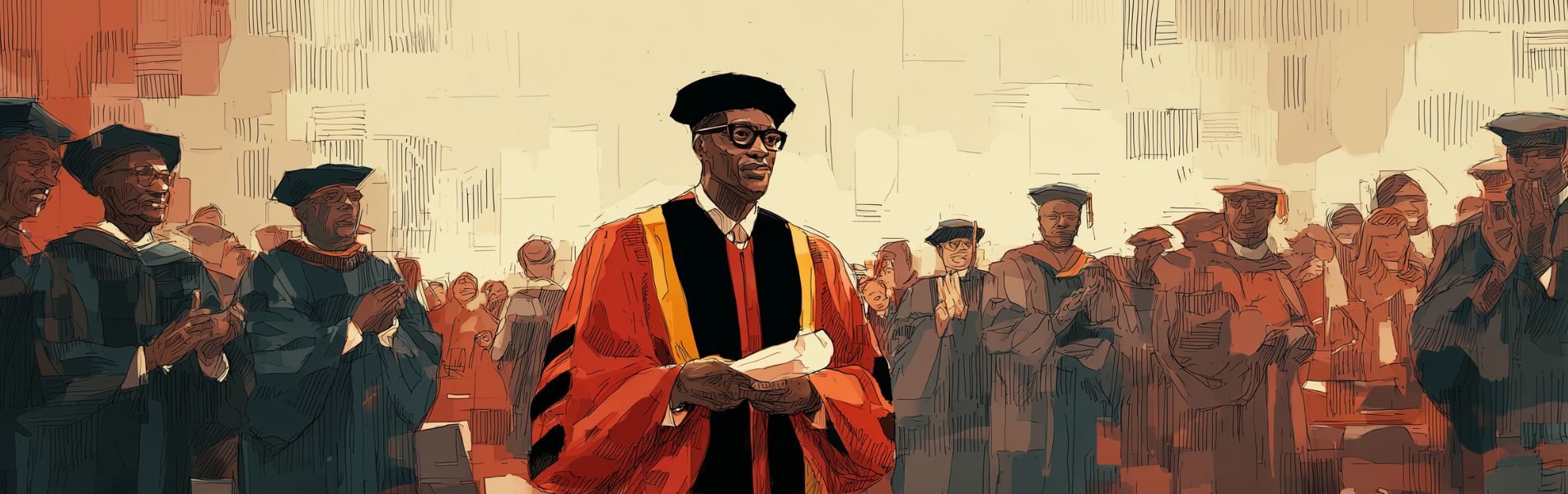
With Oakwood University’s announcement that it is inviting candidates to interview for the position of Dean of the School of Theology, I found myself sitting more upright, both physically and intellectually. I have occasionally shared what I consider to be a collective aspiration: that Oakwood should offer the full range of graduate theological degrees, including the M.Div., M.Th., and most importantly, the Ph.D. in Theology. While I have not previously mentioned the D.Min., it should be understood that my invocation of the Ph.D. includes, by extension, all advanced theological degrees, both academic and professional.
At the heart of this vision lies Oakwood’s standing as the intellectual and spiritual center of Black Adventist theology. That identity is not merely symbolic; it demands institutional boldness and theological imagination. For too long, Oakwood has been brimming with gifted, deeply formed, and well-trained Black theological minds, yet constrained in the kinds of academic credentials it can formally bestow.
Since achieving university status in the late 2000s, one would reasonably expect that the introduction of terminal degrees, especially in theology, would be a natural part of its academic trajectory. After all, it is warmly recognized as the school of the prophets. That this has not yet materialized raises important questions about long-term vision, resource commitment, and the church’s broader investment in theological education at its most symbolically significant institution.
I do not wish to speculate on why such expansion has yet to occur, nor will I attempt to assess whether the broader Adventist apparatus considers it necessary. Furthermore, I do not find it necessary to engage in comparisons with other Seventh-day Adventist institutions that achieved university status prior to Oakwood but did not pursue similar considerations. If no one raised their voice on behalf of those institutions, then that silence must be reckoned with on its own terms. The focus of this present conversation is, and must remain, Oakwood.
What I will say is this: a move in that direction would send a powerful and clarifying signal, both to the Oakwood community and to external observers, about how the Seventh-day Adventist Church understands and invests in its only HBCU. It would speak volumes about what the denomination believes Black theological leadership can and should be.
To advance this further, the dream I hold, whether one calls it a wish, a vision, or a theological imperative, encompasses not only a self-sustaining and intellectually rigorous home for African American Adventist theological scholarship but also the essential connectivity such a center can foster across the global landscape of Black Seventh-day Adventist theology. Such a space would serve not merely as a refuge but as a generative site for dialogue, collaboration, and theological construction. It would invite a deeper and long overdue engagement with the question of what Black Adventist theology is, how it functions, and why it must be understood as integral to the very fabric of Adventism itself.
Having such a university would naturally position it as the destination for those across the Adventist world seeking exposure to theological insights that have not always occupied the foreground, not because they lack value, but because they have lacked visibility. This is not a matter of casting blame or suggesting intentional neglect. Nor is it to imply a uniform unwillingness to engage what Black Adventism brings to the theological table. Rather, it is to acknowledge a reality: that the circulation of Black Adventist theological reflection has not been as extensive, or as institutionally supported, as it both can and should be.
A fully empowered Oakwood, offering terminal degrees and serving as a hub of theological imagination, would not only cultivate internal excellence but also expand the collective theological literacy of the wider church. It would also serve as a place where individuals from all racial and cultural backgrounds could come freely and without hesitation to encounter the depth and range of Black Adventist theological scholarship. This should have always been the case.
Of course, such a vision is not without its challenges. Any effort of this nature will inevitably draw criticism from those inclined to label it as a separatist impulse or as a movement attempting to steer the Black church toward a hyper-liberal posture that stands in opposition to core Adventist commitments. These critiques are not new. They often emerge from those who seek to monopolize the theological center and define orthodoxy in ways that marginalize contextual expressions of faith. Such distractions, however, can be answered not with defensiveness but with theological clarity.
The most effective response is a theology that is both rooted and rigorous. The most effective response is a theological discourse so compelling that its presence cannot be denied. I digress.
As for who should serve as Dean, I offer no specific name. I trust the community of scholars, clergy, and lay leaders to engage that question with thoughtfulness and integrity. What I do hope to see, however, is a serious conversation begin around what the search committee should be prioritizing. What experiences should the next Dean possess? What vision should they carry? What theological imagination are they bringing to the task?
In the coming weeks, many fascinating names will no doubt be floated, and I welcome the energy that this moment is generating. But as the conversation unfolds, I urge us not to lose sight of the deeper issue: the vision. Credentials matter, leadership style matters, experience matters, but what matters most is whether the next Dean will arrive with a vision capacious enough to move Oakwood into its fullest theological future.
I look forward to being challenged, perhaps even surprised, by what emerges.
While the Dean may cast vision, we must also turn the mirror toward ourselves and ask what we, as a broader community, have done to accompany and support the School of Theology’s development over time. Have we paid attention to its trajectory? Have we lent our voices, resources, or energy to its growth? What has been our collective posture toward Black Seventh-day Adventist theologians? Have we purchased their books, engaged their scholarship, listened to their lectures, invited them into our pulpits, or included them in our local and regional theological conversations?
These questions are not rhetorical. They signal a deeper concern that Oakwood’s School of Theology, despite its symbolic and historical importance, may have been left to navigate its future with little more than inherited expectation and inconsistent support. The burden of institutional advancement cannot rest solely on the shoulders of internal leadership. It must also be carried by the very community that looks to Oakwood to preserve, interpret, and advance its theological legacy.
As an ordained elder, I am cautious in how I speak about the collective weight of responsibility. I don’t want to say “we are all we got.” Yet there are moments when one must acknowledge that, for all practical purposes, we may indeed be all we have. If that is the case, then the stakes are higher, not lower. The question is not simply who will lead, but whether we will recognize and fulfill our role in sustaining what we claim to value.