


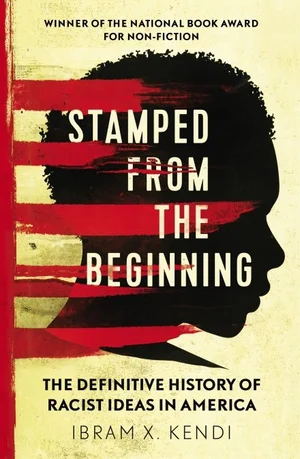
Ibram X. Kendi (PhD, Temple University) is Professor at the School of International Service and Director of the Antiracist Research & Policy Center at American University. His 2016 book, Stamped from the Beginning, is groundbreaking. It is a winner of the National Book Award and a New York Times bestseller. I concur with the accolades. Readers from all ethnic and racial groups will be challenged by its perspective. This is a must-buy.
Kendi identifies the objective of this work as narrating “the entire history of racist ideas, from their origins in fifteenth-century Europe, through colonial times when early British settlers carried racist ideas to America, all the way to the twenty-first century and current debates about the events taking place in our streets” (p. 6). He does this through five central figures while providing historical background on the individuals and philosophical currents that shaped them: Cotton Mather, Thomas Jefferson, William Lloyd Garrison, W. E. B. Du Bois, and Angela Davis.
Puritans and the Dangers of an Incorrect Remnant Theology
Kendi is right to identify the role of theology in undergirding racist ideas. Cotton Mather is presented as preaching “racial inequality in body while insisting that the dark souls of enslaved Africans would become White when they became Christians” (p. 6). He also correctly identifies the Puritans as operating with a remnant or chosen self-identity. Drawing from Kenneth Silverman’s The Life and Times of Cotton Mather (1984), Kendi notes that Puritans, as dissenters from the Church of England, believed themselves to be God’s chosen people, a special and superior community, with New England functioning as their Israel (p. 16).
Kendi’s Interpretation of St. Paul
The issue arises when Kendi turns to St. Paul (p. 17), where the apostle is presented as contributing to a “new Christianity” later relied upon by the Puritans. The problem is not that Paul is discussed, but how he is treated. The distinction between interpretation and meaning is not clearly maintained. There is a difference between saying the Puritans interpret Paul in a particular way and asserting what Paul himself means. Kendi’s phrasing collapses that distinction.
This becomes clearer on page 18, where he writes that “these antislavery and egalitarian champions did not accompany Aristotle and St. Paul into the modern era.” Here, Paul is positioned alongside Aristotle as a contributor to ideas that are carried forward, in contrast to figures such as Alkidamas, Herodotus, Lactantius, and Augustine. The implication is that both Aristotle and Paul function as sources of hierarchical thinking.
Earlier in the section, Aristotle is identified as the origin of the belief that some groups are superior to others. Kendi then moves into the common era, citing Pauline texts from 1 Corinthians and Galatians as evidence of a “God-ordained human hierarchy” (p. 17). Taken together, the section presents Aristotle and Paul as key contributors to the development of racist ideology.
Unquestionable
One general observation concerns the response to critique in race scholarship. There is often frustration when the work of social scientists is questioned, especially in discussions of race. This is understandable given the historical reality in which racist ideologies dominated public discourse while minority voices were excluded.
Understanding this context does not remove the necessity of critique. It is a mistake to allow any field to operate beyond scrutiny. When critique is dismissed on the basis of emotional impact rather than engagement with the argument itself, the field is weakened.
It is worth noting how unusual it would be for any other area of study to function this way. No discipline develops without challenge. If we apply critical standards elsewhere, they must be applied here as well. A field does not benefit from being insulated from evaluation simply because its aims are morally serious.
Featured image generated for mrjerryjacques.com