

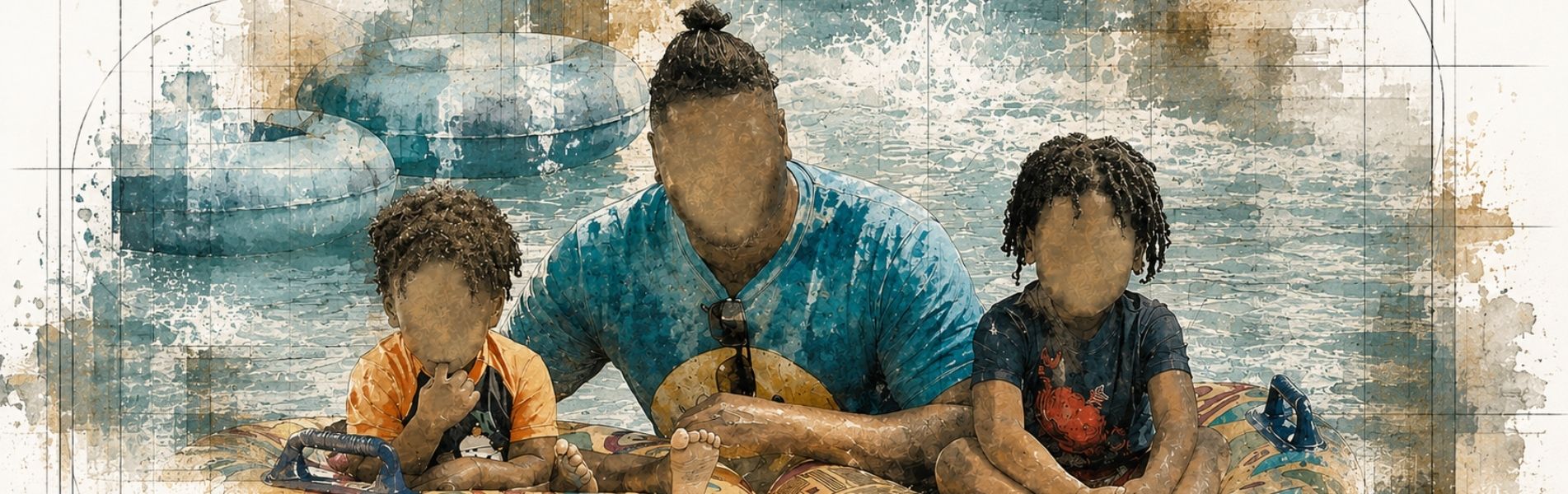
This reflection was meant to come out in April as part of Autism Awareness/Acceptance Month. But the very experience of raising autistic children made it difficult to get all my thoughts out. I probably should have kept a chart documenting the many times I had to say stop, get down, don’t touch that, don’t eat that, stop jumping, you’re making too much noise, and countless other phrases while feeling incredibly frustrated with boys who often seem determined not to listen at all. I hope this reflection captures the tension between sustained thought and the abrupt interruptions and chaos that so often fracture it.
I’ve seen parents smiling while their neurodivergent children are making endless noise and tearing through the house. I understand that once you become the parent of autistic children, entire sections of your former life quietly collapse. Certain hobbies become difficult to maintain. Certain social environments become almost inaccessible. Silence itself becomes a luxury. Even something as simple as sitting through a quiet dinner, watching a movie uninterrupted, or having a long conversation without hypervigilance starts to feel like a memory from another lifetime.
Your life slowly reorganizes itself around regulation, routines, sensory concerns, therapy schedules, monitoring behaviors, and preparing for meltdowns before they happen. People often speak about the sacrifices of parenthood generally. This feels different. It is the restructuring of existence itself around needs that go beyond what you are familiar with.
Sounding pessimistic? Let me say this clearly. I love my boys to death and put every ounce of effort into making them happy. But I want this reflection to highlight the darker sides of this parenting experience. The side where the supportive voices disappear and you are left in situations where the noise does not stop and no approach seems to work. That is when it hits you that no matter how much people attempt to clean up this experience and describe it in ways that make it seem rosy and centered around “superpowers,” there are parts of it that simply are not.
Modern society can seem to be uncomfortable with honest language regarding the experience of parents in this area. We can’t say anything without being dismissed or having our experience minimized. Everything now must be reframed into empowerment, hidden beneath therapeutic language, or transformed into something inspirational and easily consumable. Autism is often discussed in ways that allow people to feel compassionate without forcing them to confront what many families are actually carrying behind closed doors.
I do not think there is anything good about autism. It robs parents of aspects of the relationship they imagined having with their children, and it robs many children of better futures. Yes, I did say better futures. Loving my children deeply and acknowledging the difficulties of autism are not contradictions. They exist together. They exist within that tension.
Many who share autism stories do so in the hope that the world, through greater awareness, becomes more accommodating toward different kinds of people. That is necessary. However, most of the world will not adapt. Most people do not care. And if that sounds harsh, simply look at the level of funding directed toward people with developmental disabilities. Or look closer to home and observe how certain groups are discussed publicly, including how a former president running for office again was able to say that Haitians were “eating the dogs and eating the cats” without voters fleeing from him like a plague. Moments like that remind me how fragile public compassion actually is. Its the same people that we are expecting to be kind to our children?
I’ve often said that I’m a realist. That does not mean hopelessness. It means refusing to lie to myself in order to make difficult realities easier to emotionally process. It means understanding that love does not erase limitations. It means acknowledging that while awareness matters, awareness alone does not suddenly transform society into a compassionate place.
But realism does not remove the responsibility to educate, advocate, and increase awareness wherever possible. Maybe, and I believe this is true, I’ve been given a responsibility to contribute to that awareness. While I am somewhat private, I still live in the world. Questions, conversations, assumptions, and suggestions inevitably come from people who do not fully understand what my situation is.
I never thought this would happen. It never crossed my mind for even a second despite working in the developmental disabilities field for years. It simply was not something I heard people discuss in the context of having children. So when I noticed that my firstborn (AP from here on out) was not progressing at the pace expected, I immediately knew something was wrong.
Thinking back to when concerns were first shared with the pediatrician, I initially interpreted his seemingly nonchalant demeanor as a lack of concern. I remember speaking to a handful of people, very selectively because this was not something I wanted widely known, and receiving similar reactions. People were not saying much. Nobody was giving me anything hopeful to hold onto. I wanted someone to tell me I was wrong but I didn’t know that I wanted that.
I now realize that my interpretation of the doctor’s demeanor and my dissatisfaction with the reactions of others had more to do with the shock I was experiencing than anything else. At the time, I simply could not identify it as shock. The pediatrician was not a psychologist, and it would have been deeply unprofessional for him to say much beyond directing us toward specialists. Had this not been my child, I probably would not have gone down that line of thinking myself.
Working in the developmental disabilities field also meant that I already understood certain realities before entering them as a parent. I reflected on that in a previous article entitled The Crisis in Developmental Disability Care. I understood the staffing shortages, the underfunding, the exhaustion that exists within systems of care, and the fragility of structures that many families are forced to depend on for support. Experiencing that reality professionally is one thing. Experiencing it as the father of children who may one day depend heavily on those same systems is something entirely different.
The pediatrician referred us to specialists connected with his agency. As the months passed, the time eventually came when AP received his diagnosis and I had to begin settling into the reality of what was happening. Mind you, my second son (GD) was already on his way while all of this was unfolding. While it was never the plan to have them so close in age, I have often concluded that maybe it was meant to happen that way. I imagine that there would of been considerable concerns about having another child with the first one being autistic.
When I first found out that AP was on the way, I was so excited that I barely knew what to do with myself. In seconds you go from being a non-father to a father. Wow! I’m somebody’s father! Technically it happens before you even know, since the test results are simply informing you of what has already taken place. But mentally, the moment you find out is when fatherhood begins.
Growing up, I always imagined the kinds of things I would share with my children. Conversations about hobbies, careers, interests, and life itself. I’m a fitness enthusiast with years of experience in weightlifting and cardio. I imagined laying out progress charts and discussing whatever new developments existed in that space.
Having two boys even made me imagine something that some of you may roll your eyes at. One becoming a New Testament specialist and the other focusing on the Old Testament. After all, they are named after biblical figures. It would have been even funnier if the one named after the Old Testament figure became the New Testament scholar and vice versa.
But even beyond that, I looked forward to discussing careers, strengths, ambitions, and possibilities with them. Just watching their minds work through why one path interested them more than another would have been meaningful to me.
All of this may still happen. The ABA, OT, and speech services they have received at these early ages have significantly contributed to their development. I remain deeply thankful to Kat, Denise, Winnet, Martine, and Josianne. These specialists treated the boys with tremendous care and we truly could not have asked for better people. We were and are blessed.
Despite these early interventions, things may still unfold in ways where they require more assistance in life than the average person. I don’t know the future. That possibility leaves them vulnerable to the mercy, or lack thereof, of future caretakers. I carry that reality with me constantly because I know I am not eternal. Parents already worry about their children when they are away from them. Imagine carrying that concern while also thinking about a future where your child may need considerable assistance long after you are gone.
Imagine constantly wondering whether future caregivers will be patient, whether people will take advantage of them, whether they will be spoken to respectfully, whether they will be lonely, or whether they will simply become another case managed by exhausted systems and underpaid workers. Parents naturally worry about what happens to their children after they are gone. Autism intensifies those fears into something heavier and far more existential.
This exists with neurotypical children as well, but the concern becomes heavier with neurodivergent children (if that is possible?). That is why I sometimes look at how autism is publicly depicted and wonder why these realities are often absent from the conversation. Maybe some parents choose to focus primarily on the joyful moments they are experiencing now. That is understandable. It could be a coping mechanism. We all do it to some degree. I do not imagine this experience is easy for them either regardless of what they choose to share publicly.
But I wanted this side to be spoken just as loudly.
This reflection is not meant to erase the joy, affection, humor, progress, and meaning that my boys have brought into my life. Nor is it meant to discourage parents of neurodivergent children. It is simply an attempt at honesty. There are fathers and mothers quietly carrying fears they often feel pressured not to express publicly. There are parents exhausted beyond language while simultaneously loving their children with every part of themselves. Tension.
So while awareness matters, I believe realism matters too. Honest language allows people to feel seen.
It’s a hell of a world that we live in. It’s a hell of a future waiting for us all.
Emeka Buffong
Wow, this was an enlightening read for me. It was honest, balanced, and extremely beneficial for me. Thank you for being vulnerable enough to allow me to consider concerns that I did not even think of. As I ruminate on this I wonder what help can be found in our churches. What can we do as congregation leaders?
Anastasia Edmond
Jerry thank you for sharing what others are afraid to say out loud. This is the true reality that many stay quiet about. When I started in the education field I barely saw fathers involved in their autistic child or children. I became a young mother in 2001 of a child who was diagnosed with autism in 2003. I was confused do to lack education and overwhelmed due to lack of support. Once they told me the diagnosis I cried, and I thought it was a punishment I wiped off my tears and said God chose me to mother this child and I’m going to do it with his guidance and understanding. I never heard the word autism before. I never heard the word autistic when they told me that I was like oh how would you know that he’s about to be artistic that’s when I realize it was two different words with two different meanings around that time access to the Internet wasn’t as broad as it is now so I had to grasp all the information the doctors was giving me and whatever I didn’t understand I was determined to learn and ask questions I came up with a idea of if I possibly work with children in the spectrum. I can grow to understand my own child so and 2003 after my son‘s diagnosis I started working at a middle school that was right around the corner where I live. They didn’t have much access to children in the spectrum so I decided to work in a day rehab program which I had children as young as seven years old adult as old as 50 who were on the spectrum and as you know, the spectrum is very broad for mild to Severe. I dealt with a lot of different individuals and it taught me patience. It taught me understanding it taught me compassion. It taught me sympathy and empathy all at once as I built those skills, it taught me how to navigate this life with my own child. I learned the language that didn’t exist to nobody else but me and my son I built conversation that nobody understood besides me and my son my husband at that time was not supportive, so I did this on my own I can wholeheartedly say, and this experience when I try to encourage other parents, I’ve always been told you should write a book when I tell about my story my oldest son who was diagnosed with autism will be 25 years old in October. I was told he was gonna have the cognitive development of a six month old for the rest of his life. I prayed and prayed and prayed and prayed and sad Lord I know sometimes doctors are put here to give diagnosis through studies or through other experiences, but I know you other God that gives and take away and all I ask you to do is give my son vocal. I’ll accept everything else but allow him to be able to tell me how he feels allow him to be able to tell others how he feel or how they make him feel cause I think that’s one of the biggest struggle of autism the nonverbal part and my son did not start speaking so he was six going on seven and I stuck so those prayers through tears heartache. I never changed the prayer and now I can’t get him to shut up lol with that being sad continue to pray over your babies speak to God in their presence to ask what it is that you want understanding compassion patience whatever it is as a Christian Jerry I know you know God very well and there’s nothing as impossible through the father.
John Menier
My brother had no idea, but this is such a good read so influential and motivational, I can’t say that we’ve had the same experiences raising a child but I’m always learning, keep grinding and I know it takes a village, it’s been my pleasure and honor to have no known you for well over 20 plus years, keep posting and I’ll keep reading
Ellen
An honest and refreshing read. Thank you for sharing your experiences and lending your voice to the many silent parents raising neurodivergent child/ren.
Josemyrne Auplan
Thank you for allowing is to be part of your journey as a father. I understand a little of what you are facing because I have seen first hand how autistic kids are treated within the educational system; I have worked there for about a year.
I also know it is not easy and I somewhat see where your worries are coming from. However I can tell you that the Great God we serve has the whole world in his hands, including yourself and your family.
Prayers does wonders to the Father’s ears.
Every steps of the way, you will not see any of us probably, but you will see God!
Your courage will help you amd others to move forward!
ExoWatts
Great content! Keep up the good work!